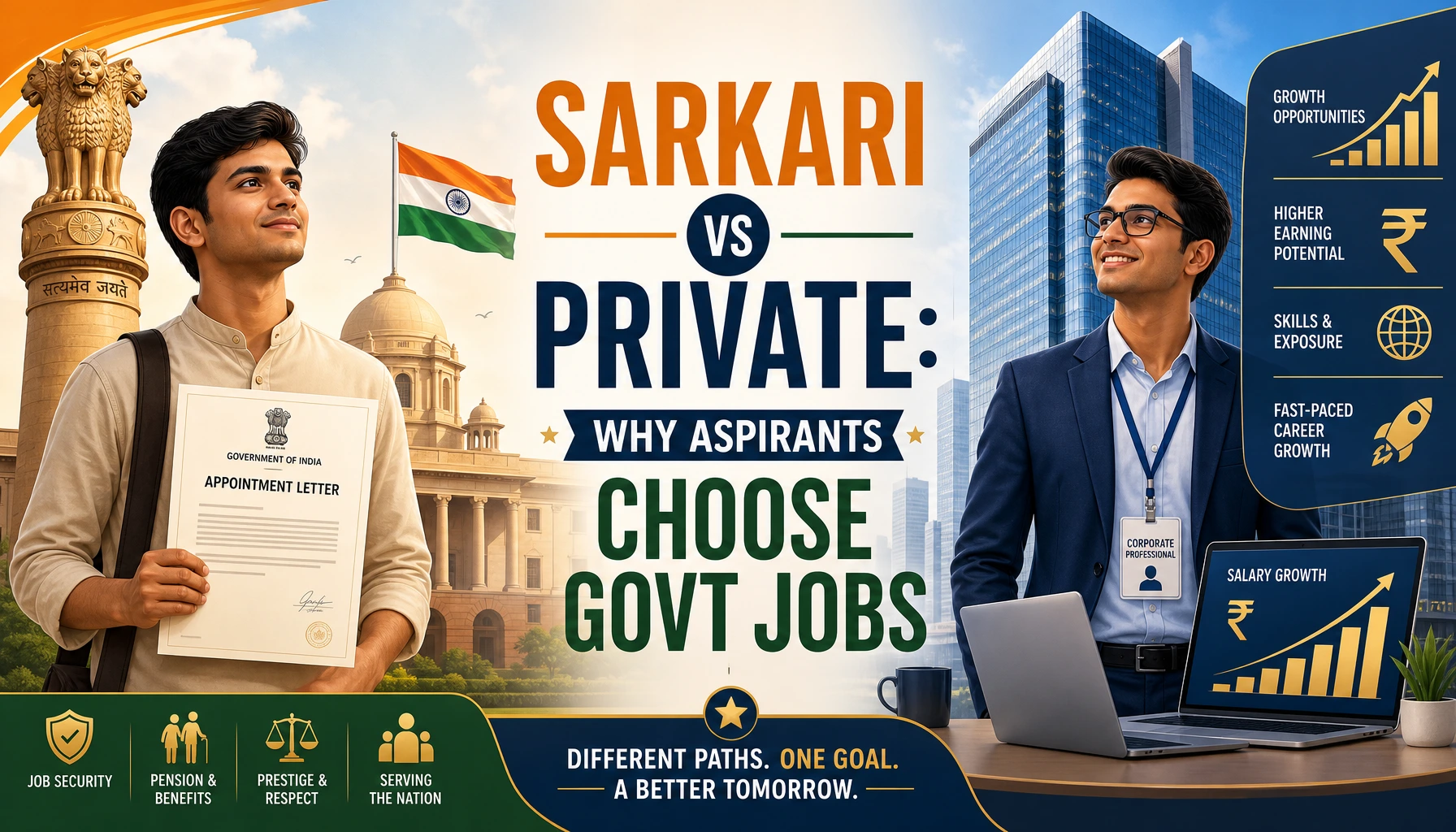
Every year, more than 2.5 crore candidates apply for government job vacancies in India, while the total number of posts advertised rarely crosses a few lakh. The SSC CGL exam alone attracts 25–30 lakh applications for roughly 15,000–18,000 vacancies. Railway recruitment drives have seen over one crore applications for a single notification. At the same time, India’s private sector — IT, banking, e-commerce, startups, manufacturing — hires far more people every year than all government departments combined.women candidates
So why does the phrase “sarkari result” still carry an emotional weight that no private offer letter can match? Why do engineering graduates with placement offers spend two or three more years in Mukherjee Nagar or Old Rajinder Nagar preparing for UPSC, SSC, or banking exams? The answer is a mix of hard economics, social reality, and personal priorities. This article breaks down both sides honestly, so you can decide which path actually fits your situation.
The Core Difference in One Line
A private job usually pays more at the start and grows faster if you perform, but almost everything about it is conditional. A government job may start slower, but almost everything about it is guaranteed — the salary, the increments, the pension structure, and above all, the fact that you will still have the job next year.NALCO Recruitment 2026
Why Lakhs of Aspirants Still Choose Sarkari Naukri
1. Job Security That No Company Can Promise
This is the single biggest reason, and recent years have only strengthened it. Between 2022 and 2025, global tech companies laid off lakhs of employees, and Indian IT services firms slowed fresher hiring dramatically. Startups that offered ₹12–15 LPA packages shut down or downsized within two funding cycles.
A government employee, once confirmed after probation, effectively cannot be removed except through serious disciplinary proceedings. There are no appraisal-linked terminations, no “restructuring,” no sudden pink slips. For a family that has seen a breadwinner lose a private job, this security is not an abstract benefit — it is the entire point.SSC Prepare
2. Salary Is Lower Only on Paper
A common myth is that government jobs pay poorly. For entry-level and mid-level roles outside the top metro tech jobs, the opposite is often true once you count everything:
| Component | Government Job (Group B/C) | Typical Private Job (Entry Level) |
|---|---|---|
| Starting in-hand (approx.) | ₹35,000–₹55,000 (post-7th CPC, Level 4–7) | ₹20,000–₹40,000 for most non-IT roles |
| Dearness Allowance | Revised twice a year, currently a large share of basic | No equivalent; raises depend on appraisal |
| HRA | 9–27% of basic depending on city | Usually part of CTC, not extra |
| Annual increment | Guaranteed 3% of basic | Performance-linked, can be zero |
| Medical cover | CGHS / state schemes for whole family, lifelong | Group insurance, ends with the job |
| Retirement | NPS with government contribution (and UPS assured-pension option for central employees) | EPF only in most cases |
| Job for spouse/dependent | Compassionate appointment provisions exist | None |
An SSC CGL Inspector or an IBPS PO in a Tier-2 city, with quarters or HRA, DA revisions, and allowances, frequently takes home more real disposable income than a private employee earning a bigger CTC in Bengaluru or Gurugram paying ₹25,000 rent.
3. Pension and Post-Retirement Life
Private employment essentially ends your income at 58–60 with whatever EPF and savings you built. Government service comes with structured retirement benefits — NPS with a 14% government contribution for central employees, the newer Unified Pension Scheme option offering an assured pension, gratuity, leave encashment, and lifelong medical coverage under CGHS or state equivalents. For a 22-year-old this feels distant; for their parents, it is often the deciding argument.
4. Social Status and the Marriage Market
It is unfashionable to say, but every aspirant knows it: in most of India, especially in Tier-2 and Tier-3 towns and rural areas, “sarkari naukri” carries a social premium no private designation matches. A Village Revenue Officer, a bank PO, a railway station master, or an SI in the state police commands respect in the community and a visibly stronger position in matrimonial discussions. A “Software Engineer at a startup” is respected in metros; a “Government Officer” is respected everywhere.
5. Work-Life Balance and Fixed Hours
Most government roles run on fixed hours, defined holidays, earned leave, casual leave, child care leave for women employees, and genuine weekends. The private sector’s average has moved the other way — the “70-hour work week” debate of 2023–24 said everything about where corporate expectations are heading. For aspirants who value time for family, health, or a life outside work, this gap matters more than a few lakh rupees of CTC.
6. Reservation, Age Relaxation, and Multiple Attempts
Government recruitment gives structured opportunities that the private sector does not: reservation for SC/ST/OBC/EWS candidates, age relaxations, PwBD provisions, and exams that can be attempted multiple times across years. For candidates from disadvantaged backgrounds or non-elite colleges, an open competitive exam is often a fairer gateway than campus placements dominated by a handful of institutes.
The Honest Case for Private Jobs
None of the above means the private sector is the wrong choice. A balanced article must say this clearly.
Faster income growth for performers. A good software developer, sales professional, or chartered accountant can double or triple their salary in five years by switching companies. A government employee’s growth is capped by pay-commission structures and promotion timelines that can take a decade.
No years lost in preparation. This is the hidden cost of the sarkari dream. Selection ratios in exams like SSC CGL or IBPS PO are often below 1%. Lakhs of aspirants spend two to five prime earning years preparing, with coaching fees and living costs, and most will never be selected. Those years of lost income and lost private-sector experience rarely enter the calculation, but they should.
Skill building and mobility. Private roles usually build market-transferable skills — coding, analytics, marketing, management — that keep options open globally. Many government roles involve routine administrative work where skills grow slowly.
Merit-driven environment. Ambitious people often find the private sector’s link between performance and reward energising, and the government’s seniority-driven promotions frustrating.
So Who Should Choose What?
Choose the government exam path seriously if security, pension, fixed hours, and social standing rank above maximum income for you; if your family situation demands a stable, transferable, respectable income; or if you can commit to a disciplined 1–2 year preparation window with a clear backup plan.
Lean towards private jobs if you are in a high-growth field like software, data, finance, or design; if you would resent slow, seniority-based growth; or if you cannot afford years without income.
The smartest middle path — one lakhs of aspirants already follow — is to take a private job and prepare simultaneously, or set a hard deadline (“two attempts, then I move on”). Banking exams, SSC, and state exams reward consistent daily preparation, and a salary removes the desperation that ruins exam temperament.
The Bottom Line
Private jobs pay for your present. Government jobs pay for your peace of mind — present, future, and retirement. Neither choice is irrational; they simply price risk differently. The lakhs of aspirants filling exam centres every Sunday are not chasing a myth. They are making a calculated bet that in an uncertain economy, a guaranteed ₹50,000 with a pension is worth more than a conditional ₹80,000 without one. Whether that bet is right for you depends on your field, your family, and how many years you can afford to invest in the attempt.
FAQs
Q1. Are government salaries really lower than private salaries? Only at the very top end. For most entry-level roles, a central government Level 4–7 post or a bank PO position pays comparable or better in-hand salary than average private jobs, once DA, HRA, allowances, and job security are counted. Elite IT and finance roles in metros do pay significantly more.
Q2. Is it worth preparing for sarkari exams after getting a private job offer? Yes, if you set a strict time limit. Take the job, prepare alongside, and cap yourself at a fixed number of attempts. Full-time preparation without income for more than two years is a serious financial and psychological risk given selection ratios below 1–2%.
Q3. Do government jobs still offer pension? Central government employees recruited after 2004 are under NPS, with the option of the Unified Pension Scheme (UPS) that provides an assured pension. Several states have also announced a return to old-pension-style benefits. Either way, retirement benefits far exceed the private sector’s EPF-only norm.
Q4. Which government exams have the best salary-to-difficulty ratio? Banking exams (IBPS/SBI PO and Clerk), SSC CGL/CHSL, RRB NTPC, and state-level exams like Group 1/2 services are popular because vacancies recur annually and preparation overlaps across them, letting one syllabus cover many attempts.
Q5. Can I switch from a private job to a government job later? Yes, as long as you meet the age limit (typically 27–32 for general category, with relaxations for reserved categories). Many successful candidates clear exams while working privately; work experience does not disadvantage you in most open competitive exams.

About the Author
ramyaji
A content writer with two years of experience in the government recruitment domain. He simplifies official notifications and exam updates for SSC, UPSC, Banking, Railways, and State PSCs, helping aspirants stay informed at every stage of their preparation.