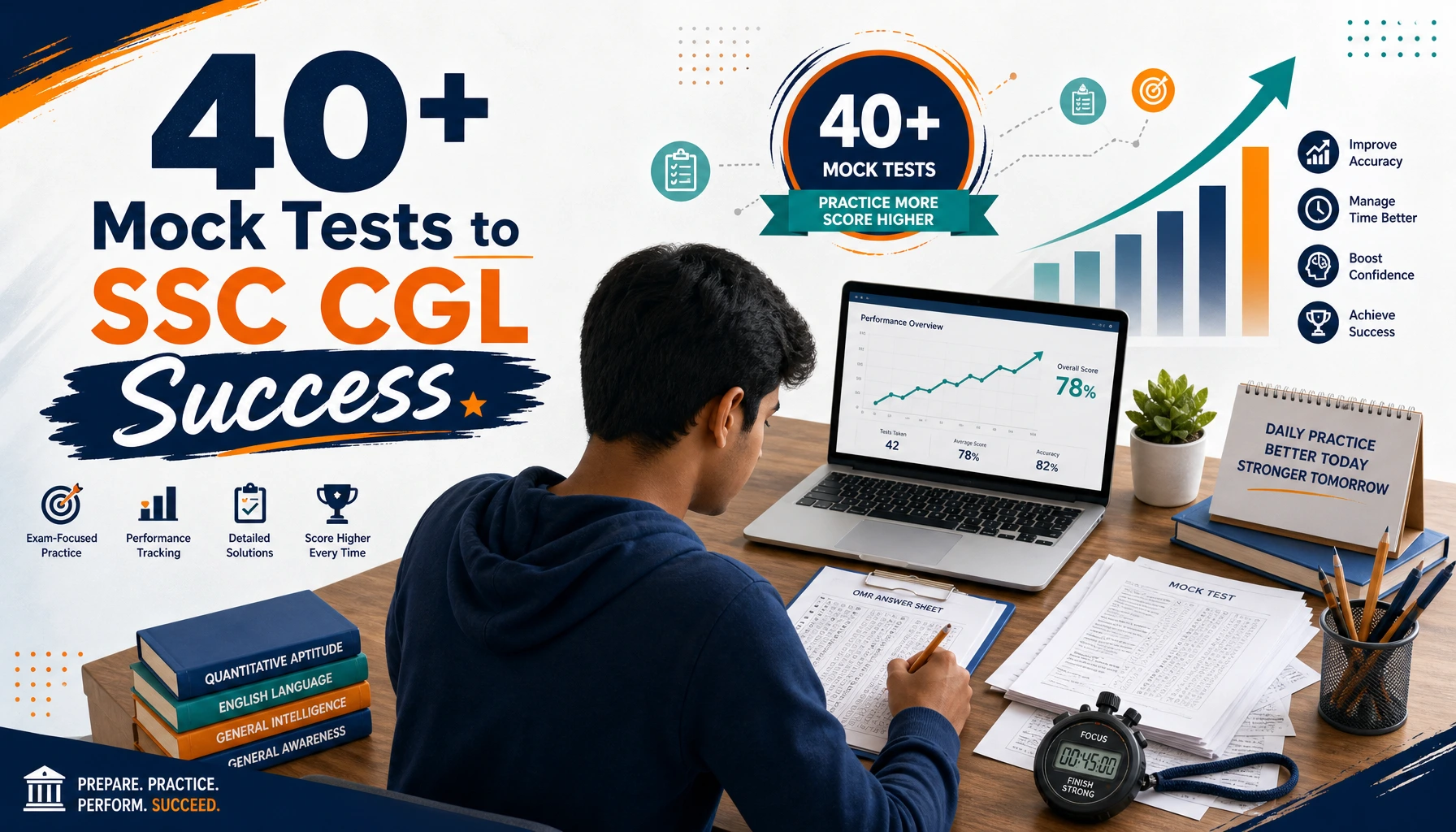
Ask any SSC CGL topper what changed their result between their first attempt and their selection year, and the answer is rarely “I studied more books.” It is almost always some version of: “I attempted far more mocks, and I analysed every single one.ssc cgl tier 1 ”
Scroll through topper interviews on YouTube and Telegram — AIR holders from CGL 2022, 2023 and 2024 — and a pattern repeats with striking consistency: most selected candidates report attempting somewhere between 40 and 70 full-length mock tests before Tier 1, plus sectional and topic-wise tests on top. Meanwhile, the average unsuccessful aspirant attempts fewer than 10–15 full mocks, often crammed into the final three weeks.
That gap is not a coincidence. This article breaks down why the 40+ mock threshold matters, what actually happens to your score curve between mock #1 and mock #40, and how to structure a mock schedule so you extract the same advantage toppers do.UP Home Guard
The Core Problem: SSC CGL Is a Speed Exam Disguised as a Knowledge Exam
SSC CGL Tier 1 gives you 100 questions in 60 minutes across four sections — Reasoning, General Awareness, Quantitative Aptitude and English. That is an average of 36 seconds per question, including reading time, calculation time and the time you spend deciding whether to skip.
Here is the uncomfortable truth most aspirants discover too late: the syllabus can be “completed” in 3–4 months, but syllabus completion contributes only part of your final score. The rest comes from four skills that no book teaches:
- Question selection — knowing within 5 seconds whether a question is worth attempting
- Time allocation — deciding how many minutes each section deserves for you, not for a generic topper
- Accuracy under pressure — maintaining 90%+ accuracy when the timer is visible
- Recovery — bouncing back after a bad section instead of spiralling
Each of these is a trained reflex, not a piece of knowledge. And reflexes are built through repetition. This is the fundamental reason toppers treat mocks as the actual preparation, not as a “test” of preparation.Delhi Police
What the Numbers Say: The Score Curve From Mock 1 to Mock 40
Aggregate the score progressions that toppers share in interviews and that test platforms publish in their year-end analyses, and a fairly consistent curve emerges. The exact numbers vary by candidate, but the shape of the curve is nearly universal:
| Mock Range | Typical Normalised Score Band (out of 200) | What Is Actually Improving |
|---|---|---|
| Mocks 1–5 | 95–120 | Exposure: you discover your real speed and weak areas |
| Mocks 6–15 | 120–140 | Time management: sectional strategy stabilises |
| Mocks 16–25 | 140–155 | Question selection: skipping becomes instinctive |
| Mocks 26–40 | 155–170+ | Accuracy and consistency: variance between mocks shrinks |
| Mocks 40+ | 165–180+ | Peak calibration: performance becomes exam-proof |
Three observations from this curve explain the entire “40+ mocks” phenomenon:
First, the biggest raw jump happens early — but it is deceptive. Between mock 1 and mock 15, scores often rise 30–40 marks simply because the candidate stops making beginner errors (attempting questions in order, over-investing in GA, panicking in the last 10 minutes). Many aspirants stop here, believing they have “learnt mocks.” They have not — they have merely stopped bleeding marks.
Second, the selection-grade improvement happens between mocks 20 and 40. This is the zone where cut-off-clearing candidates become rank-holders. The improvement here is not in average score but in variance. An aspirant at 15 mocks might score 150, then 128, then 156, then 134. An aspirant at 40 mocks scores 158, 162, 155, 160. In a normalised, single-attempt exam, your worst day matters more than your best day — and only volume compresses your worst day upward.
Third, the last 10–15 mocks are insurance against normalisation and shift variance. SSC CGL is conducted in multiple shifts with normalisation. You cannot control whether your shift gets a brutal Quant section or a lengthy English passage set. What 40+ mocks across different difficulty levels give you is pre-exposure to every shift archetype — the calculation-heavy shift, the reading-heavy shift, the tricky-reasoning shift — so that no paper pattern feels new on exam day.
The Four Compounding Advantages of High Mock Volume
1. Question selection becomes subconscious
In your first 10 mocks, deciding whether to attempt a question is a conscious decision that costs 8–10 seconds each time. Across 100 questions, that is 13–16 minutes of pure decision overhead — nearly a quarter of your exam.
By mock 30–40, pattern recognition takes over. You have seen thousands of questions. A time-and-work problem with three variables? You know from its shape whether it is a 30-second question or a 2-minute trap. Toppers routinely describe this as “the paper starts sorting itself” — easy questions announce themselves, and the trap questions get skipped without guilt.
This single skill is worth an estimated 10–15 marks, because every minute recovered from decision overhead gets reinvested into attemptable questions.
2. Your personal sectional strategy gets statistically validated
Generic advice says “do Reasoning first, GA second.” But the right order depends on your strengths, and you cannot know your optimal order from 5 mocks — the sample size is too small to separate strategy from luck.
Across 40 mocks, toppers effectively run A/B tests on themselves:
- Mocks 1–10: Reasoning → GA → English → Quant
- Mocks 11–20: GA → English → Reasoning → Quant
- Mocks 21–30: whichever order won, with time-cap variations
- Mocks 31–40: locked strategy, refined only at the margins
By exam day, their sectional order, per-section time caps and skip thresholds are not opinions — they are conclusions drawn from 40 data points.
3. Error analysis compounds like interest
A mock without analysis is worth perhaps 20% of a mock with analysis. Toppers universally report spending 1.5 to 2 hours analysing each 1-hour mock, classifying every lost mark into one of four buckets:
- Concept gap — genuinely didn’t know it → goes to the revision notebook
- Silly mistake — calculation slip, misread question → goes to the error log with the cause noted
- Time casualty — knew it, couldn’t reach it → question-selection problem
- Wrong selection — attempted a trap, burnt 3 minutes → discipline problem
Here is why volume matters for this specifically: with 40 analysed mocks, your error log becomes a statistically meaningful document. You are no longer guessing that “I sometimes mess up percentage questions” — you know that 9 of your last 40 silly mistakes came from misreading “more than” as “less than” in data interpretation. That specificity is what makes errors fixable. Ten mocks simply do not generate enough error data to reveal your true patterns.
4. Exam-day anxiety gets extinguished through exposure
Sports psychologists call it stress inoculation: repeated exposure to a stressor under realistic conditions until the physiological panic response stops firing. A candidate walking into their real Tier 1 having done 45 timed, full-length simulations has, neurologically speaking, already taken the exam 45 times. The real attempt becomes the 46th repetition of a familiar routine rather than a career-deciding singular event.
This is why toppers insist on simulating exam conditions — same time slot as their actual shift, no pauses, no water breaks, rough sheets only. The mock is not just testing content; it is rehearsing the entire performance.
Why 40 and Not 15? The Consistency Argument in One Table
Consider two candidates with the same peak ability:
| Metric | Candidate A (12 mocks) | Candidate B (45 mocks) |
|---|---|---|
| Best mock score | 162 | 168 |
| Average of last 5 mocks | 144 | 161 |
| Worst of last 5 mocks | 128 | 155 |
| Score standard deviation | High (±15) | Low (±5) |
| Probability real exam ≈ worst day | Meaningful | Meaningful |
The exam is one shot. Candidate A’s real-exam score is drawn from a wide distribution — they might score 160, or they might score 130 and miss the cut-off despite being “capable” of 162. Candidate B’s floor has been raised to 155. Toppers don’t attempt 40+ mocks to raise their ceiling; they do it to raise their floor. In a single-attempt, cut-off-driven exam, the floor is everything.
The Topper’s 40-Mock Schedule: A Practical Template
Assuming a 4-month runway to Tier 1:
Phase 1 — Months 1–2 (Mocks 1–10, roughly 1 per week + sectionals): Syllabus is still being finished. One full mock per week acts as a diagnostic. Heavy use of sectional tests (3–4 per week) for topics just completed. Analysis focus: concept gaps.
Phase 2 — Month 3 (Mocks 11–24, roughly 3–4 per week): Syllabus done; mocks become the primary study mode. Alternate-day full mocks, with the off-days dedicated entirely to analysis and error-log revision. Analysis focus: time allocation and sectional strategy experiments.
Phase 3 — Final month (Mocks 25–40+, near daily): One mock daily at your actual shift timing, analysis the same evening. Every Sunday, re-attempt only the wrong questions from that week’s mocks. Analysis focus: silly-mistake elimination and variance reduction. In the final week, taper to 3–4 easier mocks to protect confidence — never attempt a brutally hard mock 48 hours before the real exam.
Two rules toppers repeat constantly:
- Never attempt a second mock before analysing the first. Un-analysed mocks are burnt calories.
- Mix platforms. Any single test series has a house style; rotating across 2–3 series prevents you from over-fitting to one setter’s patterns — the same reason SSC’s own previous-year papers must be part of the mix.
Common Objections, Answered
“Won’t 40 mocks eat into revision time?” Mocks are revision — the highest-yield kind. A full mock plus analysis touches 100 questions across the entire syllabus and revises exactly the areas you are weakest in. No revision plan you design manually is that well-targeted.
“My scores aren’t improving after 15 mocks, so what’s the point?” A plateau at 15 mocks almost always means analysis quality is the bottleneck, not mock quantity. Check whether your error log actually names causes (“misread inequality direction”) rather than symptoms (“silly mistake in Quant”).
“Are free mocks enough?” For the first 10–15, absolutely — the early gains come from you adapting to timed conditions, not from question quality. In Phase 3, at least some mocks should come from a series known for interface and difficulty realism, because you are now training fine-grained calibration.
The Bottom Line
The 40+ mock threshold is not superstition and it is not marketing. It is the amount of repetition required to convert four conscious skills — selection, allocation, accuracy, recovery — into reflexes, and to compress your score variance so that your worst possible exam day still clears the cut-off with margin.
Books build your ceiling. Mocks raise your floor. And SSC CGL, a one-shot, normalised, cut-off exam, is won at the floor.
FAQs
Q1. How many mock tests are enough for SSC CGL Tier 1? Most selected candidates report 40–70 full-length mocks plus sectionals. Below 20, score variance typically remains too high for a single-attempt exam; 40+ is the zone where consistency stabilises.
Q2. Is it better to attempt more mocks or analyse fewer mocks deeply? Both, in sequence — but analysis is non-negotiable. The working rule: 1.5–2 hours of analysis per mock, and never start a new mock with the previous one un-analysed. Quantity without analysis produces almost no improvement.
Q3. When should I start attempting full-length mocks? After roughly 60–70% syllabus completion — usually 3–4 months before the exam. Starting earlier than that wastes mocks on concept gaps you already know exist; starting later leaves too few repetitions to build consistency.
Q4. How many mocks per week in the last month before Tier 1? Toppers commonly move to one mock daily (or 5–6 per week) at their actual shift timing, with same-day analysis, tapering to lighter mocks in the final 3–4 days.
Q5. Do sectional tests count toward the 40+ number? No — the 40+ figure refers to full-length mocks, because the skills being trained (cross-section time allocation, fatigue management, recovery) only exist in full simulations. Sectionals are supplementary, best used for weak-topic drilling.
Q6. Should I repeat mocks I have already attempted? Don’t re-attempt full mocks, but do re-attempt your wrong questions weekly. Repeating whole mocks inflates scores through memory; re-solving errors targets exactly what needs fixing.

About the Author
rajeswari_pennaluru
content writer with 2 years of experience specializing in government job notifications and results. He covers the latest updates across major recruitment sectors including SSC, UPSC, Banking (IBPS, SBI, RBI), Railways (RRB), State PSCs, and other central and state government departments. From exam notifications and admit cards to answer keys, cut-offs, and final results, he delivers accurate and timely information to help aspirants stay ahead in their preparation. With a clear and aspirant-friendly writing style, he simplifies complex recruitment details and guides candidates at every stage of their government job journey