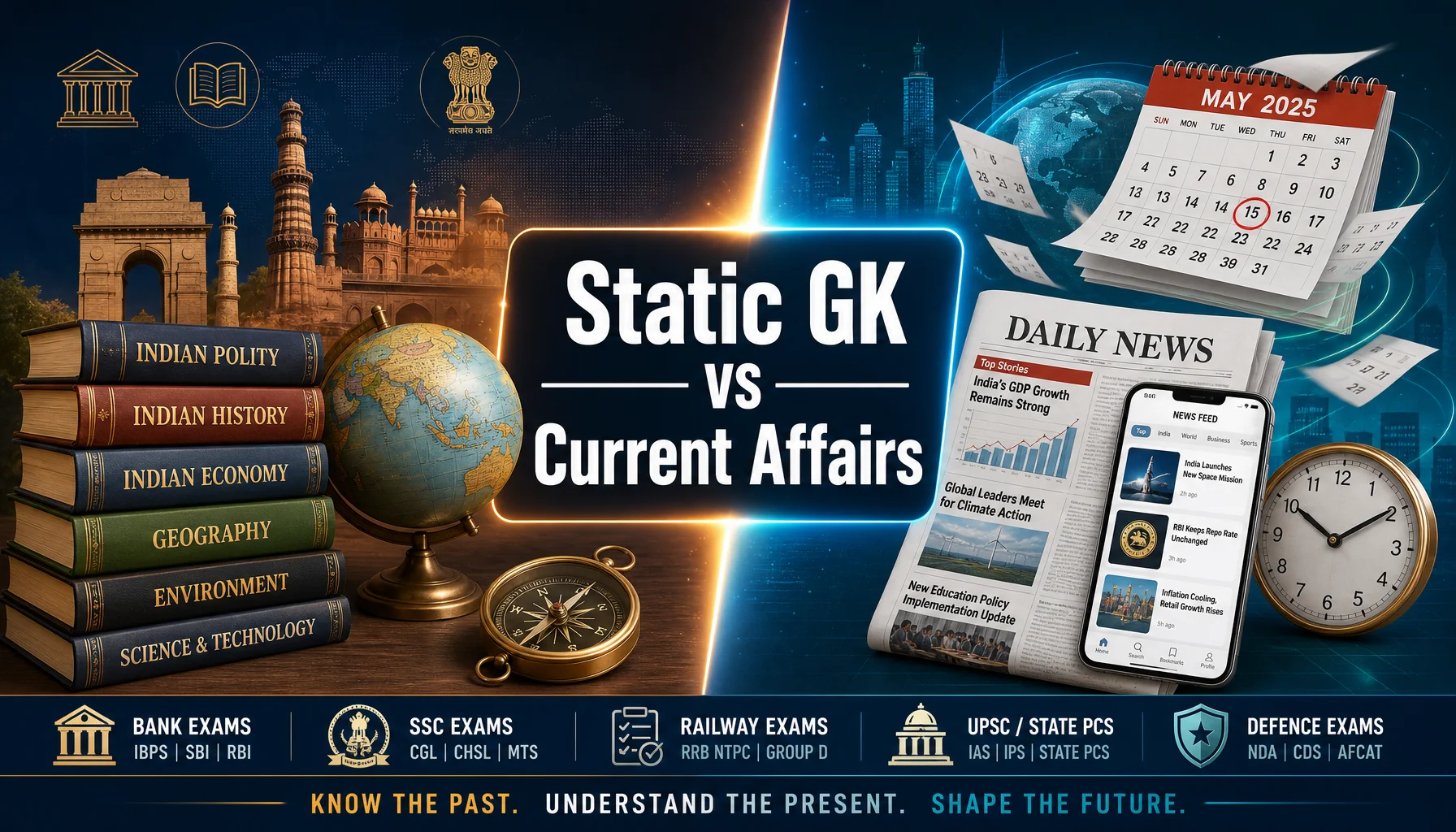
If you’re preparing for competitive exams like IBPS, SBI, SSC CGL, or the Railways, you’ve probably faced a common dilemma: should you spend more time memorizing static general knowledge or keeping up with the daily flood of current affairs? Both sections carry significant weight, and neglecting either can cost you crucial marks. The truth is, success isn’t about choosing one over the other—it’s about understanding how they differ and allocating your time wisely. In this article, we’ll break down static GK and current affairs, compare their roles across major exams, and give you a practical strategy to balance both.SBI PO 2026
Understanding the Basics
Before diving into strategy, it’s important to know exactly what each of these categories covers, because they demand very different study approaches.
What is Static GK?
Static general knowledge refers to facts and information that rarely change over time. These are the timeless building blocks of your general awareness. Topics typically include:
- History (freedom struggle, dynasties, important battles)
- Geography (rivers, mountains, national parks, states and capitals)
- Indian Polity and Constitution (fundamental rights, articles, amendments)
- Static economy (banking terms, RBI functions, economic concepts)
- Art and culture, dances, festivals, and monuments
- Science fundamentals (physics, chemistry, biology basics)
- Books and authors, awards, important days
The advantage of static GK is that once you learn it thoroughly, it stays with you. The article on the Right to Equality won’t change next month, and the capital of Australia won’t shift overnight.
What are Current Affairs?
Current affairs, on the other hand, are dynamic and constantly evolving. This section tests your awareness of recent developments across the country and the world. UPSSSC Lower PCS 2026 It generally covers:
- National and international news
- Government schemes and policies
- Sports events, tournaments, and record holders
- Awards and honors announced recently
- Appointments (new CEOs, governors, ambassadors)
- Summits, agreements, and MoUs
- Banking and financial news, RBI monetary policy updates
- Science and technology breakthroughs
The challenge with current affairs is its ever-changing nature. What’s relevant today may be forgotten in six months, which means consistent daily effort is essential.
How Each Section Weighs in Different Exams
The importance of static GK versus current affairs varies significantly depending on which exam you’re targeting. Understanding this can help you prioritize.
Banking Exams (IBPS, SBI, RRB)
In banking exams, the General Awareness section leans heavily toward current affairs—especially banking and economic news from the last 4-6 months. Roughly 60-70% of the GA section is based on recent events, RBI policies, government financial schemes, and appointments. Static GK, particularly static banking awareness, fills the remaining portion. If you’re a banking aspirant, current affairs should be your top priority.SSC Prepare
SSC Exams (CGL, CHSL, MTS)
SSC exams flip the equation. The General Awareness section here is dominated by static GK—history, geography, polity, and general science make up the bulk of questions. Current affairs still appear, but they form a smaller slice, usually around 15-25% of the GK section. For SSC aspirants, building a rock-solid static foundation is non-negotiable.
Railways (RRB NTPC, Group D)
Railway exams strike a middle ground, with a strong emphasis on general science and static GK, complemented by a decent share of current affairs. Static awareness and basic science concepts often carry the day here.
Static GK vs Current Affairs: A Quick Comparison
- Shelf life: Static GK is permanent; current affairs are time-sensitive.
- Study method: Static GK requires memorization and revision; current affairs require daily reading and consistency.
- Effort curve: Static GK demands heavy upfront effort; current affairs need steady, ongoing effort.
- Return on time: Static GK gives long-term returns across multiple attempts; current affairs must be refreshed for every exam cycle.
Building a Balanced Study Strategy
Now that you understand the landscape, here’s how to divide your time effectively without burning out.
1. Align Your Focus with Your Target Exam
If banking is your primary goal, dedicate more energy to daily current affairs, especially the banking and economy segment. If SSC is your focus, front-load your preparation with static topics and treat current affairs as a supplement. Many aspirants prepare for multiple exams simultaneously—in that case, aim for a genuine 50-50 split.
2. Make Current Affairs a Daily Habit
Consistency beats cramming when it comes to current affairs. Spend 20-30 minutes each day reading a reliable daily current affairs digest. One-liner formats and short descriptive notes in both Hindi and English are especially useful for quick revision. Attempting a daily quiz reinforces what you’ve read and highlights weak spots.
3. Schedule Static GK in Focused Blocks
Static GK is best tackled subject by subject. Devote dedicated study sessions to one topic at a time—for example, a week on Indian Polity, then a week on geography. Use tables, mind maps, and flashcards for facts like important days, awards, and constitutional articles.
4. Revise Smartly
For current affairs, compile monthly capsules and revise them right before the exam. For static GK, follow a spaced-repetition schedule so facts stay fresh. Regular revision is what separates candidates who forget from those who recall confidently under pressure.
5. Test Yourself Regularly
Mock tests and daily quizzes are your best friends. They train you to recall facts quickly, manage time, and identify gaps. Try to attempt both a static GK quiz and a current affairs quiz every day to keep both muscles active.
Common Mistakes to Avoid
- Ignoring current affairs until the last month before the exam—this leads to overwhelming backlog.
- Memorizing static GK without revision, causing you to forget most of it.
- Reading too many sources for current affairs and confusing yourself—stick to one or two trusted digests.
- Applying a banking strategy to an SSC exam or vice versa, without adjusting the balance.
Conclusion
Static GK and current affairs aren’t rivals—they’re two halves of the same score-boosting whole. Static GK rewards deep, one-time learning with lasting returns, while current affairs demand daily discipline and timely revision. The smartest candidates don’t ask “which one matters more?” Instead, they tailor their balance to the exam they’re targeting and stay consistent throughout. Combine focused static study with a daily current affairs routine—supported by regular quizzes in your preferred language—and you’ll walk into the exam hall with a well-rounded general awareness that’s tough to beat.

About the Author
kalpana_megam
I am a content writer with 2 years of experience specializing in government job notifications and results. He curates and simplifies the latest updates on recruitment notifications, exam schedules, admit cards, answer keys, and results from various central and state government departments. With a keen eye for accuracy and timeliness, he helps job aspirants stay informed about upcoming opportunities and navigate the competitive exam landscape with ease. His writing focuses on delivering clear, reliable, and aspirant-friendly information to guide candidates at every step of their government job journey.