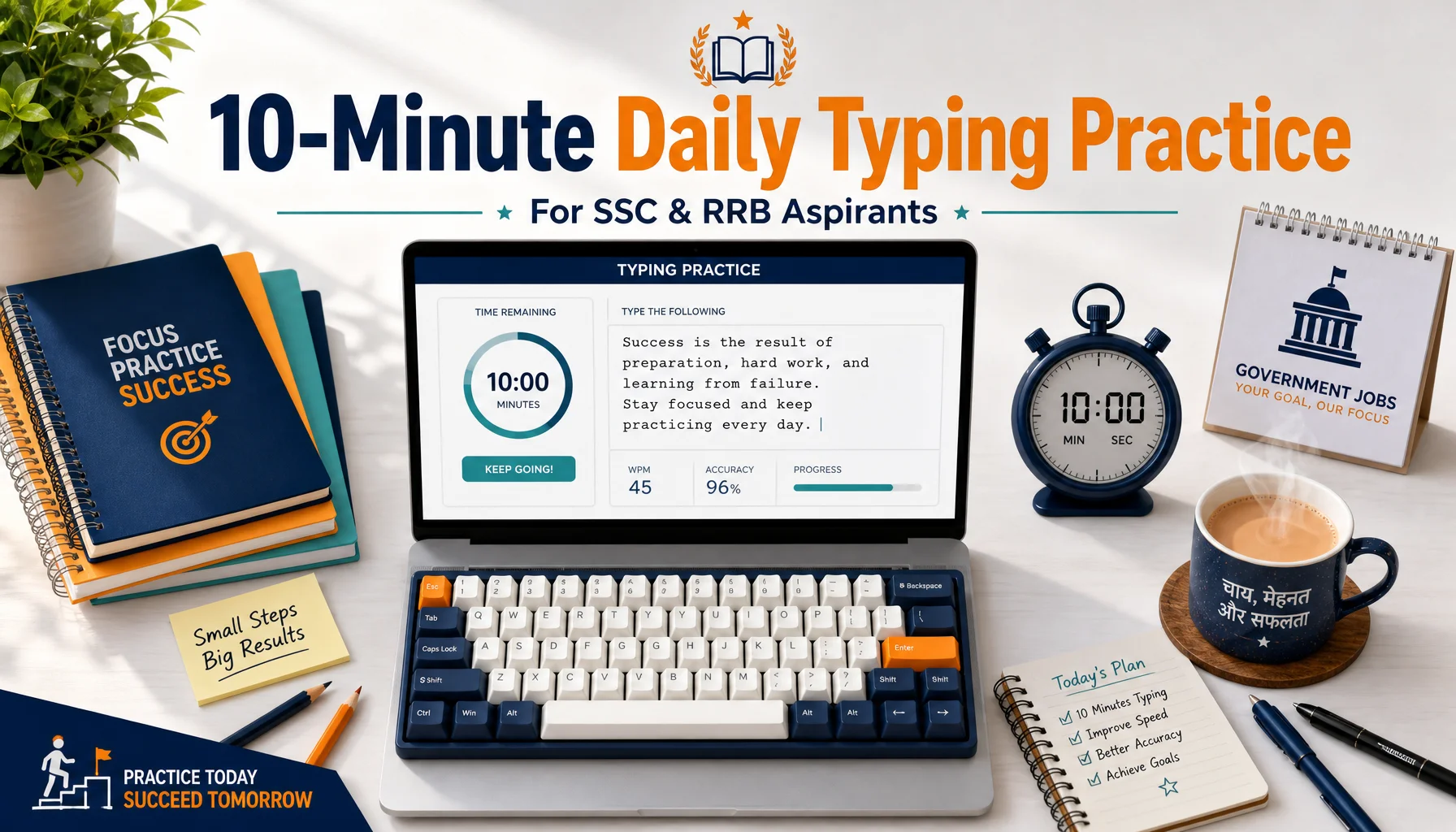
If you’re preparing for the SSC or RRB typing test, you already know that speed alone won’t get you through. The real challenge is building consistent speed with high accuracy—and that only comes from daily, focused practice. The good news? You don’t need hours of drilling. Just 10 minutes a day with the right kind of exam-style passages can transform your typing performance over a few weeks.Eligibility Criteria
This article gives you a collection of ready-to-use practice paragraphs modeled on actual SSC and RRB typing test content, plus a simple daily routine you can follow. Bookmark this page, open your typing software or an online test tool, and start typing along.
Why a Daily 10-Minute Routine Works
Typing is a motor skill, much like playing an instrument or driving. Your fingers need repeated, spaced practice to develop muscle memory. Long, exhausting sessions once a week are far less effective than short, regular ones. Here’s why the 10-minute approach is ideal for exam aspirants:
- It’s sustainable. You’re more likely to stick to a 10-minute habit than a 1-hour ordeal.
- It mirrors the exam. SSC CGL/CHSL typing tests typically last around 10 minutes, and RRB skill tests are similar in length. Practicing at exam duration trains your stamina and focus.
- It reduces fatigue errors. Short sessions keep your fingers fresh, so you build good habits instead of rushing through mistakes.
- It compounds. Small daily gains in words per minute (WPM) add up dramatically over 4–6 weeks.
Understanding the SSC / RRB Typing Standards
Before you practice, it helps to know your target. While requirements can vary by post and year, the SSC 2026 in">general benchmarks are:
- English typing: around 35 words per minute (roughly 10,500 key depressions per hour).
- Hindi typing: around 30 words per minute (roughly 9,000 key depressions per hour).
- Accuracy: aim for at least 90–95%. Excessive mistakes can disqualify you even if your raw speed is high.
Always confirm the exact criteria in your official notification. But for daily training, focus on hitting 35+ WPM in English with 95% accuracy—if you can do that comfortably, you’ll be in a strong position.
Your 10-Minute Daily Typing Routine
Follow this structure every day. It balances warm-up, focused practice, and review.
Minutes 0–2: Warm-Up
Type a few simple sentences slowly, keeping your fingers on the home row (ASDF – JKL;). Don’t chase speed here—just wake up your fingers and check your posture. Sit straight, wrists relaxed, eyes on the screen (not the keyboard).
Minutes 2–8: Timed Passage Practice
Pick one passage below and type it under a timer. Do not look at the keyboard. If you make a mistake, correct it and keep going. The goal is to complete the passage while maintaining a steady rhythm.Eligibility Criteria
Minutes 8–10: Review and Note
Check your WPM and accuracy. Note which keys or words tripped you up. Keep a small log of your daily scores—watching them improve is powerful motivation.
Practice Passage 1: General Awareness
India is a country of remarkable diversity, home to many languages, religions, and traditions. Its rich cultural heritage has evolved over thousands of years, blending ancient customs with modern ideas. The people of this vast nation take pride in their festivals, art, and history. Education and hard work remain the keys to progress, and every citizen has a role to play in building a stronger and more united future for all.
Practice Passage 2: Work and Discipline
Success in any examination depends on regular effort and steady discipline. A candidate who studies a little every day often performs better than one who works hard only at the last moment. Good habits, such as planning your time and reviewing your mistakes, help you improve slowly but surely. Patience and confidence are important qualities. Never give up when the task seems difficult, for consistent practice always brings excellent results in the end.
Practice Passage 3: Technology and Society
Modern technology has changed the way we live and work in countless ways. Computers, mobile phones, and the internet have made communication faster and easier than ever before. People can now share information, learn new skills, and connect with others across great distances. However, we must use these tools wisely and responsibly. Balancing screen time with real life keeps us healthy, focused, and better able to reach our goals.
Practice Passage 4: Nature and Environment
The natural world around us is full of beauty and wonder. Tall trees, flowing rivers, and clear skies remind us how precious our environment truly is. Yet human activities have caused serious harm to nature over the years. It is our duty to protect forests, save water, and reduce pollution. Small steps taken by each person, such as planting trees and avoiding waste, can help create a cleaner and greener planet.
Tips to Improve Faster
Passages alone won’t build your skill unless you practice smart. Keep these principles in mind:
- Never look at the keyboard. This is the single biggest habit that separates fast typists from slow ones. It may hurt your speed at first, but it pays off quickly.
- Prioritize accuracy over speed. Speed grows naturally once your accuracy is solid. Chasing WPM while making mistakes only reinforces bad habits.
- Use proper finger placement. Each finger should be responsible for specific keys. Stick to standard touch-typing technique.
- Practice punctuation and numbers. Many exam passages include commas, capital letters, and figures. Don’t ignore them.
- Simulate exam conditions. Once a week, do a full mock test in a quiet room with no distractions.
Track Your Progress Weekly
Set a small, measurable goal for each week. For example:
- Week 1: Focus purely on accuracy—hit 95% even if speed is low.
- Week 2: Increase speed by 3–5 WPM while keeping accuracy above 90%.
- Week 3: Practice longer passages and reduce backspacing.
- Week 4: Take daily mock tests at full exam duration.
By comparing your logs each week, you’ll clearly see improvement, which keeps you motivated even on days when practice feels tough.
Conclusion
Cracking the SSC or RRB typing test isn’t about natural talent—it’s about smart, consistent practice. Just 10 focused minutes a day, using exam-style passages like the ones above, can steadily push your speed and accuracy toward the required standards. Start today, track your numbers, and stay patient. In a few weeks, you’ll be typing with the confidence and control you need to pass the test comfortably. Open a timer, pick a passage, and begin—your future self will thank you.

About the Author
rajeswari_pennaluru
content writer with 2 years of experience specializing in government job notifications and results. He covers the latest updates across major recruitment sectors including SSC, UPSC, Banking (IBPS, SBI, RBI), Railways (RRB), State PSCs, and other central and state government departments. From exam notifications and admit cards to answer keys, cut-offs, and final results, he delivers accurate and timely information to help aspirants stay ahead in their preparation. With a clear and aspirant-friendly writing style, he simplifies complex recruitment details and guides candidates at every stage of their government job journey